
T-Shape is not a t-shirt type
Or what does it mean today spread over the comfort zone


🎬 Introduction
Being attached or entrenched in one's skills as the sole lever for success or achieving tangible results, and while it has always been essential to have vertical expertise and develop it comprehensively, we are facing a reality where the nature of things is pushing almost in the opposite direction - almost - because it is undoubtedly essential to master one's area of expertise, but especially in the last two decades, this "reality" is weakening in favor of one that deals with uncertainty, complexity, and agility.
What does it mean in the context of a team?
This post provides an overview and reflection on the relations between skills, people, and teams. Even if a team is definitely built of individuals, it is an organism acting and performing in a way that allows those individuals to spread out beyond their comfort zone.
🔥 The challenge
Responding to the continuing demands of skills and abilities is one of the most challenging things happening nowadays, and that's true for individuals but especially for teams.
While discussing what it means to be a team is a topic for a different discussion, the general belief—or better, the general approach—is that people always tend naturally to divide the parts composing a team into skills and roles. This is usually true because the hard truth stays in what the majority imagines a team as a group of people working together.
🧜♂️ The myth
Let’s be clear: a team is, for sure, a group of people working together, but the why and the how to dramatically change the meaning of that sentence.
There are two main myths about teamwork and its function:
put some people together, each with its own area of expertise, and it’s done
put some people together, sometimes in a common space (even virtual..), give them a project, establish roles, and it’s done
There’s also another one that is probably not so much related to t-shaped teams, but it’s so funny I can’t avoid mentioning: when you are in a rush, add people (to the team) to deliver earlier (sorry, I couldn’t resist)
Unfortunately, things never go as easily as they seem; it would be wonderful if they took so little “effort.” There’s a huge amount of literature on team management and team practices, and as said, this post will not cover this field.
👨🌾 The reality
Two fundamentals play a dramatic role in how a team acts and performs: trust and skills; they are so related that the majority can’t figure out how possible.
The reality is that people when put together, struggle to work together toward an objective, or at least, it takes time to make it work. Various reasons exist, and unfortunately, this dramatically impacts achievements, results, and “performance.” This has much more to do with human dynamics than “skills“ (read technical skills).
Again, unfortunately, many out there, especially the ones with “decision power”, consider human dynamics, culture, and trust only fancy words, thinking something like, “Oh please, we need to produce, so work, work, work, these are things for fancy richer companies “ or “We don’t need opinions, we need doers“.
🏛️ Trust
There’s a lot written out there about what the word “trust” means - since I don’t want to repeat and bother readers (even if I believe talking about trust is never enough ) thus, let’s say
Trust is the foundation of a performing team.
In 1965, Mr. Bruce Tuckman proposed a model—known as the Truckman model—describing the model and the phases necessary for a team to grow and be successful. He used other words, but for the conversation, let’s consider “successful“ for a team as being able to deliver value, grow, and face challenges.
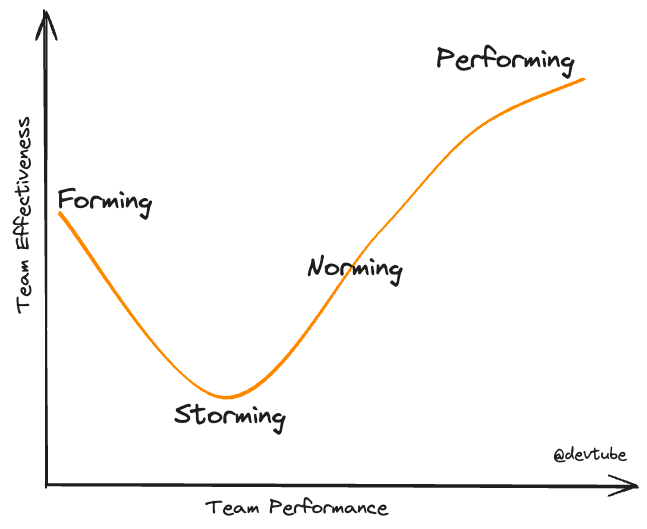
I don’t want to go through the model (look below in the references), but let’s say every team needs to go through Forming and Storming to start Norming and then perform.
One can think, “Oh, please, If I choose the best tech people on the market now, what could go wrong?” Well, that’s exactly what usually happens because people, before building on tech or skills, build on human skills (sorry, I hate the word soft skills; it means nothing, IMHO).
The area between Forming, Storming, and Norming is where the foundations of “trust“ are laid, which relies primarily on human skills.
🏛️ Skills
Skills are (usually) what represent one's ability, expertise, and comfort zone, where people feel confident and solid, but unfortunately, that’s not enough.
It’s not enough because (as represented below) usually, skills and expertise are silos of knowledge, where - since comfort zone makes us feel confident & safe - one can act and intervene as a “star” or simply as a good professional, but since they are a team, and is the team who win or fail; there’s the need of a completely different availability and approach.
There are countless examples of why siloed knowledge isn’t as good as it seems, and the literature on this topic is huge, but again, I don’t want to cover this here.
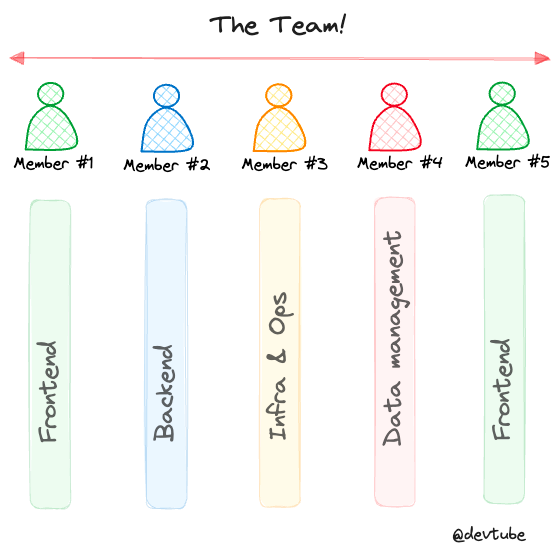
Let's say that siloing drastically reduces delivery capacity, increases the risk of loss of ownership, increases the risk of knowledge loss, increases the risk of failure, and the list could go on and on. (to mention some drawbacks)
🪢 T-shape people
Let’s consider the “knowledge silos“ as something structural: each team member has their “functional” area of expertise, and that’s obvious, but we need to go over considering the team a cross-functional team where the knowledge is not a blocker but something to share, because
where knowledge is a silo, it tend to be protected, where knoledge is an expertise it tend to be shared, and that's where T-shaped people comes into the game.
Introduced probably for the first time in 1991 by Mr. David Guest, the term T-shaped (people or skills) refers to the knowledge model each one of us has, represented with the form of a T (yes, the letter):
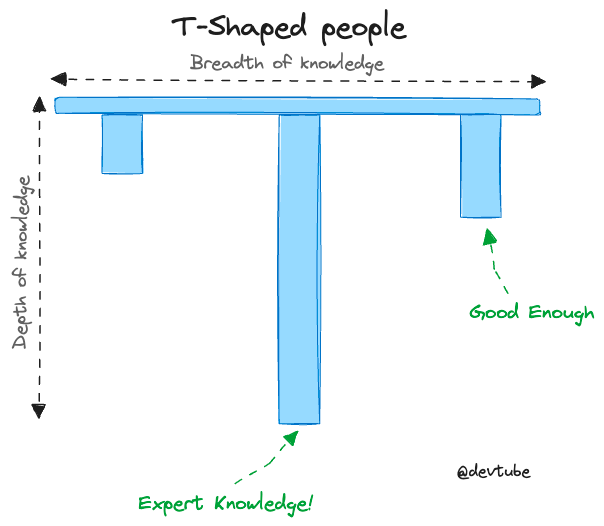
We all know many things; that’s the breadth of knowledge; this could be technical knowledge, something about our preferred hobby, etc. Let’s consider the technical knowledge for now.
We all have an area of expertise, and while we are good enough in something different, that’s the depth of knowledge; raise the hand who’s never heard “we can’t be experts in everything“
In T-shaped, team skills are more important than roles because T-shaped team members naturally improve team collaboration and delivery flow, reducing dependency on individuals. (the latter is the worst drawback of siloed teams and knowledge)
🧑🎓 A.C.U.(men)
let’s come back to the challenge:
Responding to the continuing demands of skills and abilities is one of the most challenging things happening nowadays, and that's true for individuals but especially for teams.
While researching and practicing for Agile Teams and T-shaped people, I invented 😂 a new acronym a.c.u.men, standing for Agility, Complexity, Uncertainty, and men (in the sense of humans)
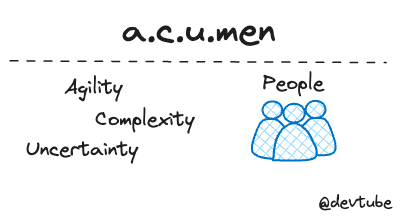
The a.c.u.men concept describes what nowadays a team needs to handle and tackle to be successful:
Agility, meaning the capacity of a team to
reactrespond, and adapt to changeComplexity means having the “weapons” to deal with it since complexity is everywhere, even when people with decision-making power think how stupid it could be and thus, what the f***, how long it could take.
Uncertainty refers to the degree of uncertainty that naturally accompanies the impossibility of "planning" the future. This is for various reasons, but mainly because the future depends on complex factors that cannot be "predicted" or predetermined. This has a lot to do with the concept of complexity but, above all, with Agility.
These are a reality, and even if one wants to pretend otherwise or imagine being able to grasp and manage such factors, the "harsh" reality is different: Agility will always be needed to manage Complexity when dealing with various degrees of Uncertainty.
It requires the acumen to step out of one's comfort zone embracing a T-shaped
knowledgeculture
🔖 The references
As usual, next are some references if you’re interested in going deeper:
Trust is the key to performing teams:
✌️ Closing
That's all for today! I would love to hear from you; receiving feedback is the healing of sustainable and sane growth. Please don't hesitate to contact me on LinkedIn or Twitter.